
Do you know which laws apply to the data your company collects — and where that data actually ends up? If you use tools from the US, the honest answer is: it’s complicated. More and more European businesses are asking the same question and quietly switching to EU-based software. Not out of ideology, but out of practicality. This guide is here to help you find European alternatives for digital services and products — from webinar platforms and email marketing to cloud storage, search engines, and messaging apps.
Table of Contents
Key Insights
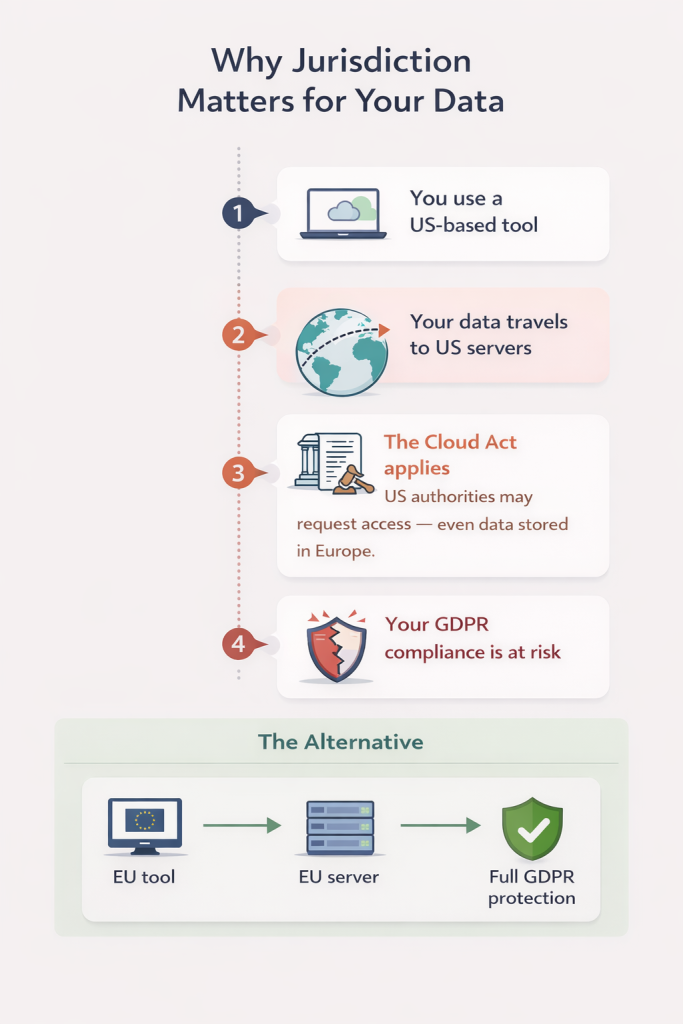
- The Cloud Act and Schrems II ruling mean US-based providers can be required to disclose data stored anywhere in the world — including on EU servers.
- GDPR compliance is a legal requirement in the EU — choosing European providers simplifies that compliance significantly.
- ClickMeeting is the European alternative to Zoom and Microsoft Teams for companies running webinars and online events.
- EU alternatives now cover virtually every category: search engines, browsers, office suites, messaging apps, analytics, cloud storage, and CRM.
- Switching doesn’t mean sacrificing features — many European tools match or exceed their US counterparts on functionality.
- Digital sovereignty — Europe’s ability to act independently in the digital world — is increasingly a business concern, not just a political one.
Why Europeans Are Rethinking Their Software Stack
Let’s start with some context. In 2020, the Court of Justice of the EU invalidated the Privacy Shield agreement in a landmark case known as Schrems II. The ruling found that US law doesn’t offer EU citizens adequate protection against surveillance by American intelligence agencies. That put thousands of companies using US tools in a legal grey zone overnight.
Then there’s the Cloud Act — a US law that can compel American companies to hand over data stored on their servers anywhere in the world, including within the EU. It doesn’t matter if the server is physically in Frankfurt or Amsterdam; if the company is US-based, the Act may apply. For organizations handling sensitive personal data, contracts, client information, or healthcare records, that’s a real compliance and reputational risk.
The European Parliament has pushed hard for digital sovereignty — the idea that Europe should be able to act independently in the digital space. This translates into concrete regulatory pressure through the Digital Markets Act, the Digital Services Act, and ongoing enforcement of GDPR. European companies building digital services and products have to comply with these rules from day one. Many US providers are still catching up. 
To be fair, the landscape isn’t black and white. The EU–US Data Privacy Framework, adopted in July 2023, created a new adequacy mechanism for transfers to the US — though it has already faced legal challenges. And not every ‘European’ tool uses exclusively European infrastructure; some EU-based companies still host on US hyperscaler platforms. Worth checking before you switch.
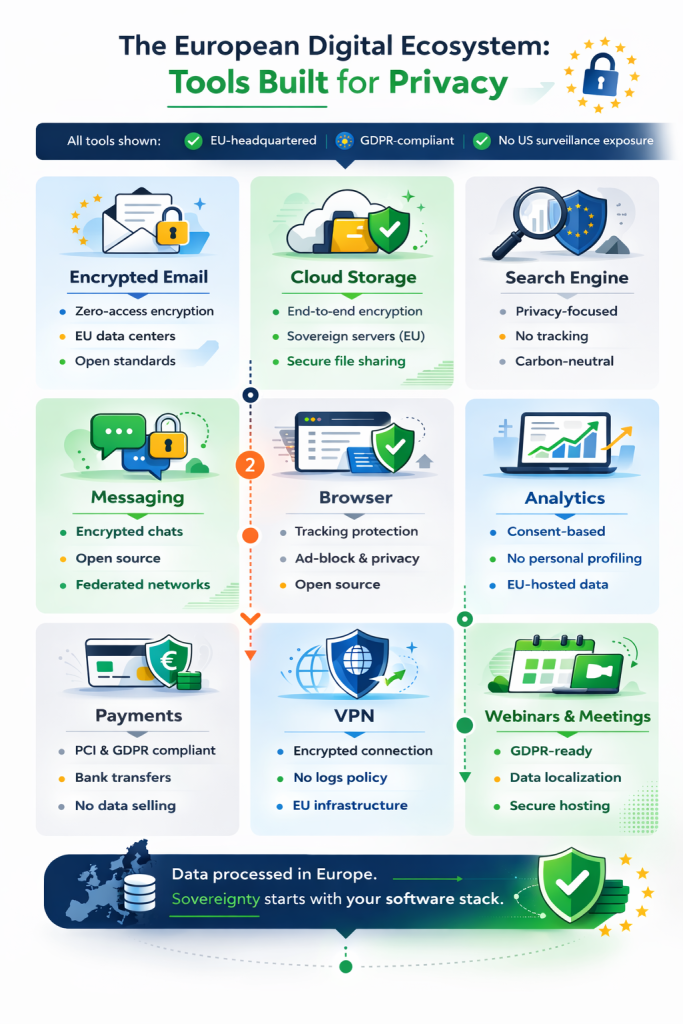
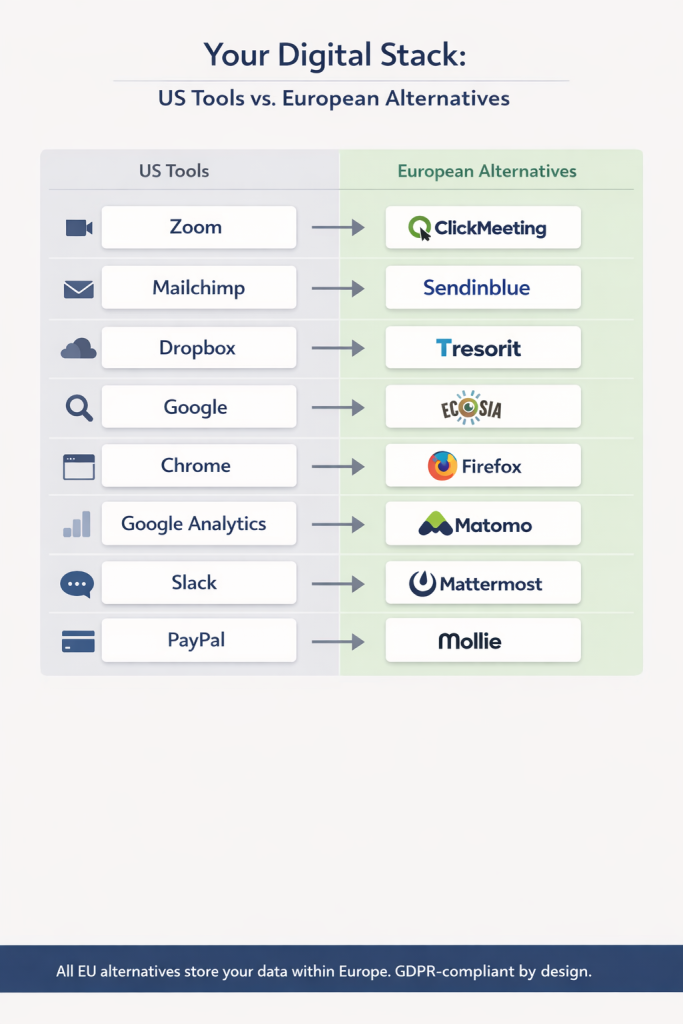
Quick Reference: US Tools and Their European Alternatives
| US Tool | EU Alternative | Why Switch? |
| Zoom Webinars | ClickMeeting | EU servers, GDPR compliance, ISO 27001 certified |
| Microsoft Teams / Zoom | ClickMeeting, Whereby, Nextcloud Talk | Full data control, self-hosting options |
| Mailchimp | GetResponse | Polish HQ, EU data residency, built-in AI features |
| Gmail / Outlook | Proton Mail, Tuta | End-to-end encryption, zero-access architecture |
| Threema, Wire, Olvid | E2E encryption, no phone number required | |
| Google Analytics | Piwik PRO, Plausible | No personal data collected, stays within the EU |
| Google Drive / Dropbox | Nextcloud, Tresorit | Self-hosted or zero-knowledge encrypted |
| Microsoft 365 | LibreOffice, ONLYOFFICE, Collabora | Open source, no vendor lock-in |
| Google Search / Bing | Qwant, Ecosia | No tracking, no ad profiling |
| Chrome | Vivaldi | Privacy-first browser built in Norway |
| HubSpot / Salesforce | ClickMeeting + Pipedrive | Webinar-native lead gen, EU-compliant pipeline |
| PayPal | Adyen, Mollie, Przelewy24 | European payment processors, local market coverage |
Webinar and Online Meeting Software: The European Alternative to Zoom and Microsoft Teams
Think about what happens during a webinar. Attendees register — giving you their names, email addresses, job titles, sometimes their company size or industry. They engage with polls, answer questions, click links. That’s a rich dataset of personal data collected in real time, tied to a business relationship. Now ask yourself: where does that data go, and whose legal jurisdiction applies to it?
Zoom and Microsoft Teams dominate the market, but both are US-based. That means the Cloud Act risk applies. For B2B companies running lead generation webinars or online events with clients, jurisdiction and the processing chain matter.
ClickMeeting: The European Alternative to Zoom Webinars
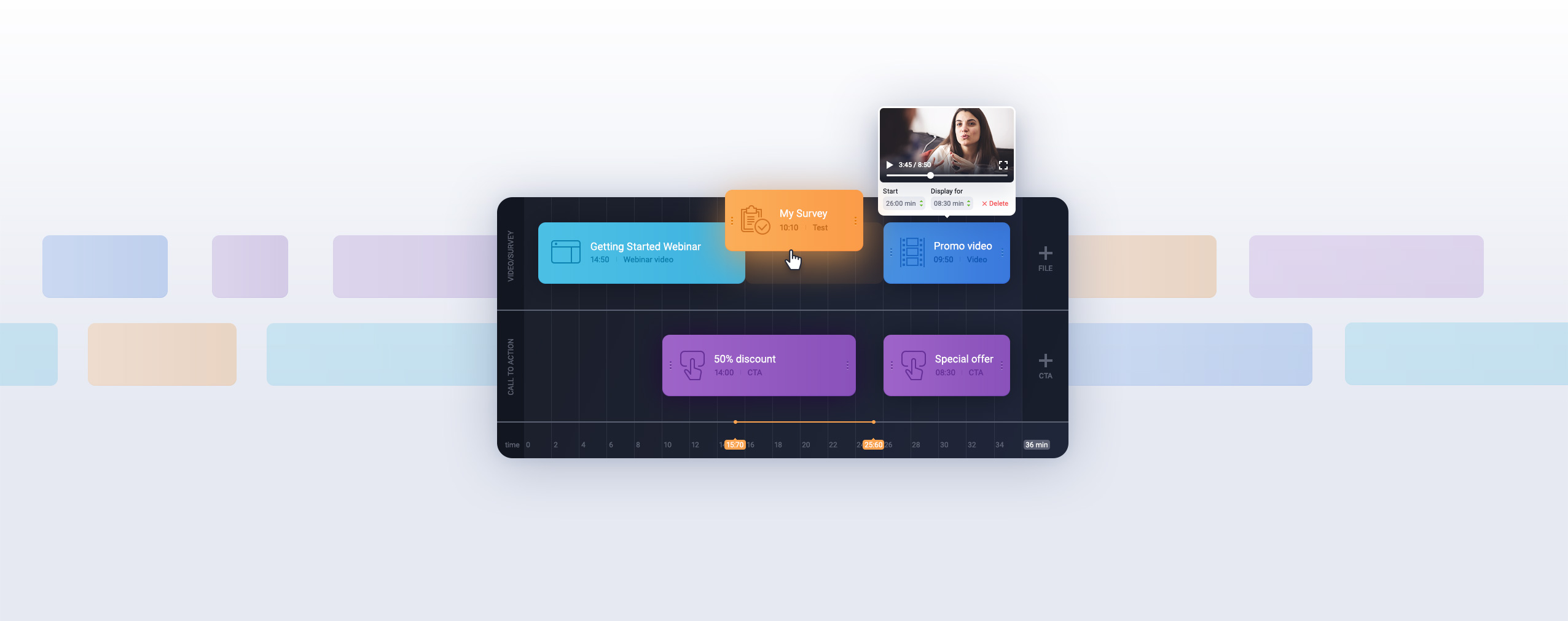
ClickMeeting is a webinar and online meeting platform built in Europe, developed with GDPR compliance and data protection in mind. It’s the European alternative to Zoom Webinars and GoToWebinar — and it offers the full feature set you’d expect from an enterprise-grade platform.
- Registration and landing pages — custom forms, branded event pages, automated confirmations
- Live, automated, and on-demand webinars — full flexibility for how you deliver content
- Analytics and reporting — attendance, engagement rates, poll results, watch time
- End-to-end encryption and ISO/IEC 27001:2022 certification for security-conscious organizations
- Online payments — paid webinar ticketing via Stripe and PayPal integrations
- CRM integrations — participant data flows directly into tools like Pipedrive
- EU server infrastructure — data stays in Europe, processing complies with GDPR
Products like Zoom Webinars come with a broad integration ecosystem — and ClickMeeting matches that across CRM, marketing, and payment tools. The difference is the legal foundation underneath.
“European companies running webinars are collecting valuable lead data — registration details, engagement signals, purchasing behavior. That data deserves the same level of protection as any other business asset. Choosing a platform that processes data within the EU isn’t just a compliance checkbox; it’s a fundamental decision about who you trust with your customers’ information and your business reputation.”
— Tomasz Bołcun, Brand Manager @ ClickMeeting
Other European Alternatives for Online Meetings
If your needs are simpler — quick team calls rather than large-scale webinars — there are solid options from across Europe:
- Whereby (Norway) — a lightweight, browser-based video meetings tool. No download required, clean UX, privacy-conscious approach.
- Pexip (Norway) — built for enterprises with strict data governance requirements, including self-hosted deployment options.
- Infomaniak kMeet (Switzerland) — ethical videoconferencing solution hosted in Switzerland, with clear encryption and privacy commitments.
- Nextcloud Talk — an open source alternative to Microsoft Teams for organizations that want to run their own server and keep all data on-premise.
The self-hosting model is particularly compelling for public sector organizations and regulated industries. When data never leaves your own infrastructure, jurisdictional questions about Cloud Act exposure become largely moot.
Email Marketing and Messaging: EU-Based Alternatives to Mailchimp and WhatsApp
Email marketing is one of the most GDPR-sensitive activities a company can run. You’re collecting consent, processing personal data, tracking engagement — all of which falls squarely within the regulation’s scope. So who processes that data, and under what legal framework, actually matters.
GetResponse: European Alternative to Mailchimp
Mailchimp is the default choice for many businesses, but the European alternative to Mailchimp is GetResponse — a platform headquartered in Gdańsk, Poland. It combines email marketing, automation, funnels, forms, and webinars in one ecosystem. It includes AI-powered features like product recommendations, which puts it in direct competition with US platforms — except the data stays within the EU.
Other European firms worth considering in this category:
- Brevo (France) — strong GDPR credentials, widely used across Europe
- MailerLite (Lithuania) — clean UX, GDPR-compliant infrastructure
- CleverReach (Germany) — built for German data privacy standards, robust automation
European Alternatives for Messaging Apps
WhatsApp is owned by Meta — a US company — and is used daily for sensitive business communication. If that makes you uncomfortable, there are strong alternatives built with privacy-first principles:
- Threema (Switzerland) — the European alternative to WhatsApp. End-to-end encryption, works without a phone number or email to register.
- Wire (Germany/Switzerland) — end-to-end encrypted team messaging, positioned as a business alternative to Slack and Teams.
- Olvid (France) — a secure messenger adopted by French public institutions, with no central directory and no metadata collection.
- Element — based on the open Matrix protocol, supports self-hosting and federated communication across organizations.
And then there’s Mastodon — a federated, transnational social network where no single company owns the infrastructure. It represents a genuinely participatory model of online communication — collaborative, decentralized, and built on a philosophy of equality and culture beyond a single nation-state or corporate interest. Civil society organizations and academic institutions have been early adopters.
Encrypted Email: Proton, Tuta, and the Case for Privacy-First Inboxes
Most people don’t think twice about using Gmail or Outlook for business email. But if you work in legal, finance, healthcare, or any sector where confidentiality matters, the fact that your emails pass through US servers under US jurisdiction is worth considering.
Proton (Switzerland) offers encrypted email built on a zero-access encryption model — even Proton itself cannot read your emails. It’s the most widely known privacy-first encrypted email provider, built on years of transparency and independent audits. Proton also offers a VPN with annual no-logs audits, adding an additional layer of protection against US surveillance.
Tuta (Germany) takes a similar approach — automatic end-to-end encryption for your entire mailbox, including calendar. Both are strong choices if you’re moving a team off Gmail or Outlook for compliance or confidentiality reasons.
Search Engines and Browsers: European Alternatives to Google, Bing, and Chrome
We accept Google as the default for search engines and Chrome as the default browser without much thought. But these tools track users extensively — building advertising profiles based on your search history, location, device, and browsing behavior. For individuals and organizations concerned about data privacy, there are genuine alternatives built across Europe.
European Search Engines and Browsers at a Glance
| Tool | Country | Category | Key Strength |
| Qwant | France | Search engine | No search history, no advertising profile built on users |
| Ecosia | Germany | Search engine | Privacy-focused + ad revenue funds tree planting (climate angle) |
| Vivaldi | Norway | Browser | Feature-rich browser alternative to Chrome; strong user control |
| Proton | Switzerland | Email / VPN / Cloud | Full privacy-first suite; zero-access encryption across services |
Qwant (France) builds no advertising profile and keeps no search history. Ecosia (Germany) adds a sustainability angle — it uses ad revenue to plant trees — making it a popular choice for climate-conscious users. Vivaldi (Norway) is a thoughtful browser alternative to Chrome, offering extensive customization without Chrome’s data collection. The EU’s Digital Markets Act is also pushing for greater interoperability — which may gradually improve the visibility of these European providers in search engines results.
If you want to find European alternatives for digital tools systematically: the European Alternatives directory (european-alternatives.eu) and Switch-to.eu both act as a directory to help you find European alternatives across dozens of software categories — a great starting point for auditing your stack.
Cloud Storage, Cloud Services, and Office Suites: Keeping Your Data in Europe
Cloud storage is arguably the most sensitive category on this list. Files, documents, contracts, financial records — everything lives in the cloud now. If that cloud is operated by a US company, the Cloud Act risk applies. For regulated industries across Europe, this is increasingly a hard line.
European Cloud Storage Options
The European alternative to Google Drive is either the self-hosted Nextcloud or the encrypted Tresorit cloud — depending on whether you want to manage your own infrastructure or prefer a managed service.
- Nextcloud (Germany) — self-hosted file storage, collaboration, and communication platform. Widely used by European public sector organizations for digital sovereign deployments. When you control the server, you control the data.
- Tresorit (Switzerland) — zero-knowledge end-to-end encrypted cloud storage. Excellent for legal and financial firms that need confidential file sharing.
- pCloud (Switzerland) — Swiss-based cloud storage with optional zero-knowledge encryption through its ‘Crypto’ feature.
- Koofr (Slovenia) — EU-based with no tracking and explicit GDPR compliance communication, a solid option for teams within the EU.
European Cloud Services and Hosting
For organizations building their own applications, European cloud services providers offer a real alternative to AWS, Azure, and Google Cloud:
- OVHcloud (France) — one of the largest European cloud providers, with data centers across Europe and strong GDPR compliance messaging.
- Hetzner (Germany) — ‘Made in Germany’ hosting, popular among developers for competitive pricing and unambiguous German data protection standards.
- Scaleway (France) — a European cloud provider with infrastructure offerings also targeting AI workloads.
- Infomaniak (Switzerland) — ethical cloud platform committed to European data storage and GDPR compliance.
Office Suite Alternatives to Microsoft 365 and Google Workspace
If your team uses Microsoft Office or Google Docs, there are solid EU options for an office suite that reduce lock-in to the US tech ecosystem and keep document data within European jurisdiction:
- LibreOffice — backed by The Document Foundation in Berlin. The most mature open source office suite available, covering documents, spreadsheets, and presentations.
- Collabora Online — brings LibreOffice functionality to the browser in a self-hosted model. Full user control over your data.
- ONLYOFFICE (Latvia) — particularly praised for its compatibility with Microsoft formats, which matters a lot in practice when working with external partners.
- CryptPad — collaborative document editing with end-to-end encryption, ideal for particularly sensitive content.
Analytics and Cybersecurity: European Alternatives to Google Analytics and US Security Tools
Here’s a category where the regulatory stakes are high. Analytics tools collect IP addresses, identifiers, and behavioral data — all of which can qualify as personal data under GDPR. Transferring that data outside the EEA without adequate safeguards is a compliance problem. The European Data Protection Board investigated Google Analytics specifically, with the Austrian supervisory authority ruling its use in breach of GDPR as far back as 2022.
The European alternative to Google Analytics is Piwik PRO or Plausible — both purpose-built for the EU compliance environment:
- Piwik PRO (Poland) — enterprise analytics platform with built-in consent and request management. Data stays in the EU, designed for regulatory compliance from the ground up.
- Plausible (Estonia) — no cookies, no personal data collected, and processing never leaves the EU. Lightweight and easy to implement.
- Simple Analytics (Netherlands) — privacy-first from installation, GDPR compliant by design.
European Cybersecurity Tools at a Glance
| Tool | Country | Category | Key Strength |
| Mullvad VPN | Sweden | VPN / Privacy | Strict no-logs policy, minimal user data retention |
| Proton VPN | Switzerland | VPN / Privacy | Annual no-logs audits, strong encryption, EU-based |
| ESET | Slovakia | Cybersecurity | Long-established European endpoint protection |
| G DATA | Germany | Cybersecurity | German-engineered antivirus and endpoint security |
| NordPass | Lithuania | Password Manager | Zero-knowledge encryption for credentials |
| Proton Pass | Switzerland | Password Manager | End-to-end encrypted, part of the Proton ecosystem |
| Piwik PRO | Poland | Analytics | EU-first analytics, consent management built in |
| Plausible | Estonia | Analytics | No personal data collected, never leaves the EU |
One final note on jurisdiction and supply chains: in any organization’s cybersecurity posture, the chain of sub-processors matters. The Cloud Act doesn’t just apply to the primary vendor — it can extend to US-owned companies processing data on behalf of others. Understanding your full processing chain is part of responsible governance, not just IT.
Lead Generation, CRM, and Online Payments: European Alternatives to HubSpot and Salesforce
When you think about lead generation, the default tools are usually HubSpot and Salesforce — both US companies. But if your lead generation happens through webinars, there’s a compelling European alternative that handles both the event platform and the data pipeline.
ClickMeeting is the European alternative to the ‘HubSpot + Zoom’ combination for companies running webinars as part of their lead generation strategy. Registration forms with custom fields, branded landing pages, participant databases, automated follow-up sequences, and direct CRM integrations — it covers the whole funnel. Participant data exports directly into CRM systems like Pipedrive, letting your sales team act on leads without manual work.
For European companies building out a broader MarTech stack, notable options include:
- Livespace (Warsaw, Poland) — a CRM built for the European market, with strong pipeline management
- SALESmanago (Kraków, Poland) — customer engagement and marketing automation platform with an AI layer and EU data residency
- GetResponse (Gdańsk, Poland) — combines email, automation, funnels, and webinars with AI-powered features
European Payment Alternatives to PayPal
PayPal and Stripe are the defaults for most businesses, but there are strong EU-native alternatives — particularly if you want to ensure your online payments infrastructure stays within European jurisdiction:
- Adyen (Netherlands/Amsterdam) — one of Europe’s largest and most respected payment processors, used by major European companies.
- Mollie (Netherlands) — a clean, developer-friendly payment platform serving businesses across Europe with strong multi-currency support.
- Przelewy24 (Poland) — one of the largest online payment operators in the Polish market, well-integrated into local e-commerce and SaaS platforms.
ClickMeeting’s paid webinar feature supports payment integrations with Stripe and PayPal, and also communicates PayU support for Polish customers — giving you flexibility depending on which payment providers your audience already trusts.
European Alternatives for Collaboration: Cross-Border Tools Built in the EU
Cross-border collaboration — across teams in different EU countries, with clients in different jurisdictions, using shared documents and video calls — is exactly the kind of use case where software choices really matter. Every tool you add to that workflow is another potential point of data exposure.
Many European companies have standardized on tools like Nextcloud for file sharing, ClickMeeting for events and client-facing webinars, and Element or Wire for internal messaging — creating a stack that keeps the majority of their data within the EU, with strong privacy commitments at every layer.
This kind of software sovereignty doesn’t require abandoning every US tool overnight. Most organizations take a pragmatic approach — starting with the highest-risk categories (email, webinars, analytics) and working outward. The important thing is to know what you’re using, understand the jurisdictional risks, and have a plan.
The European Union now offers one of the strongest frameworks for digital rights in the world — but that framework only protects you fully if the tools you use actually operate under it. European providers, by definition, have to. US tech providers are working toward it. That gap, however narrow it gets, is where the real risk sits.
FAQ: European Alternatives to Big Tech
- Why should I consider European alternatives to US software?
Primarily for legal compliance and risk management. The Cloud Act allows US authorities to compel American companies to disclose data stored anywhere in the world, including on EU servers. Choosing EU-based providers reduces exposure to this risk and simplifies GDPR compliance.
- What is the best European alternative to Zoom for webinars?
ClickMeeting is the leading European alternative to Zoom Webinars. It’s built in Europe, processes data on EU servers, holds ISO/IEC 27001:2022 certification, and offers a complete feature set including registrations, automation, on-demand webinars, and paid event ticketing.
- Is there a European alternative to Google Analytics?
Yes. Piwik PRO (Poland) and Plausible (Estonia) are both strong EU-based analytics platforms. Plausible in particular collects no personal data and processes everything within the EU. Simple Analytics (Netherlands) is another privacy-first option.
- What European encrypted email providers are available?
The two main options are Proton Mail (Switzerland) and Tuta (Germany). Both offer end-to-end encryption as standard, with zero-access encryption ensuring even the provider cannot read your messages.
- What’s a good European alternative to WhatsApp?
Threema (Switzerland) is the most widely recommended European alternative to WhatsApp. It doesn’t require a phone number or email to register, offers end-to-end encryption, and doesn’t store metadata. Wire and Olvid are strong alternatives for business communication.
- Are there European alternatives to Google Drive and Dropbox?
Yes — several. Nextcloud (Germany) for self-hosted deployments, Tresorit (Switzerland) for end-to-end encrypted managed cloud storage, pCloud (Switzerland) for a consumer-friendly option, and Koofr (Slovenia) for an EU-based team storage solution.
- What European search engines should I consider?
Qwant (France) and Ecosia (Germany) are the two main European search engines. Qwant builds no advertising profile; Ecosia adds a sustainability angle by using ad revenue to fund tree planting.
- Is there a European browser alternative to Chrome?
Vivaldi — a browser built in Norway — is a strong, feature-rich alternative to Chrome with a clear privacy stance and extensive customization options.
- Does being ‘European’ guarantee my data stays in the EU?
Not automatically. Some EU-headquartered companies use US hyperscaler infrastructure. Always check data processing agreements and sub-processor lists. The key questions are: where is data processed, and whose legal jurisdiction applies?
- Where can I find a comprehensive directory of European software alternatives?
European Alternatives (european-alternatives.eu) and Switch-to.eu are two useful directories that help you find European alternatives for digital tools across dozens of categories. They cover cloud services, communication, productivity, security, and more.


 (3 votes, average: 3.67 out of 5)
 Loading...