
Every webinar, meeting, or online event generates hours of spoken content. Most of it gets archived and forgotten. But what if you could turn every word into searchable, actionable text — automatically, with accurate transcription, and without buying a separate transcription tool?
That’s exactly what AI transcription makes possible. And if you’re already using ClickMeeting, you don’t need to look anywhere else.
📌 Key Takeaways
- AI transcription is built into ClickMeeting — every paid plan includes the transcription feature, so there’s no need to pay for a separate transcription service.
- Powered by OpenAI’s Whisper, ClickMeeting’s engine delivers fast and accurate transcription across multiple languages, handling different accents with ease.
- The workflow is simple — record your event, navigate to your recordings library, click “AI transcription,” and your transcript is ready within minutes.
- Transcripts are editable and searchable — download as TXT, use timestamps to create subtitles, or upload a file directly to AI tools like ChatGPT for content repurposing.
- One recording becomes many assets — blog posts, meeting notes, follow-up emails, social media posts, and more, all generated from a single transcript.
- Your data is protected — ClickMeeting’s data privacy and security policies ensure that your audio recordings and transcripts are not used to train any AI models.
What Is AI Transcription — and Why Should You Care?
AI transcription is the process of turning spoken audio into written text using artificial intelligence. Unlike manual note-taking, which is slow and error-prone, an AI-powered transcription engine uses advanced speech recognition to capture every word in real time or from a recording.
Tools like Otter have popularized this idea for individual users — Otter’s free plan offers a limited number of transcription minutes per month, making it accessible for light use. But for organizations running webinars, online training sessions, or team meetings at scale, a purpose-built transcription tool embedded directly in your event platform is far more practical. 
The difference matters. When you use a standalone transcription service, you have to export audio recordings, upload a file, wait for results, and then manually sync everything back to your workflow. With ClickMeeting’s built-in AI transcription, the process is seamless — you record directly in the platform, and the transcript is ready without leaving your account.
How Does AI Transcription Work?
Modern AI transcription software uses deep learning models trained on vast libraries of audio and video to recognize speech patterns. The best AI engines — including the one powering ClickMeeting — are built on state-of-the-art architecture like Open AI’s Whisper, which supports multiple languages and handles background noise, multiple speakers (multi-speaker recognition), and varying accents remarkably well.
Here’s the basic process: the system receives a recording, analyzes the audio using speech recognition algorithms, and converts turning spoken words into text with timestamps attached to each segment. The result is a searchable text file that reflects who said what and when.
What sets AI-powered transcription apart from older approaches is accuracy. Earlier speech-to-text tools struggled with accents, crosstalk, and technical vocabulary. Today’s models — the ones driving the best AI transcription tools on the market — handle these challenges far better, making the transcript genuinely usable without extensive manual cleanup.
AI-Powered Transcription = High Quality
Artificial intelligence assists us in really many fields. It makes it possible to automate many processes that previously took a lot of time and effort. The outcomes are not inconsiderable: you achieve better results more easily and quickly. This also applies to audio transcription of your recordings.
With the power of artificial intelligence, ClickMeeting’s AI transcription stands out for its high quality. What was said by presenters and attendees during the event will be accurately reflected in written form. Keep in mind that mistakes can happen even to the most sophisticated technology — it’s worth reviewing the transcription before you send it to your attendees or publish it anywhere.
And another important perk: you get access to AI transcription in any paid ClickMeeting plan. You don’t need to purchase access to additional tools, sign up for a separate transcription service, or manage a separate transcription software subscription.
Want to transcribe your webinars automatically?
Try ClickMeeting free for 14 days — no credit card required. Record your first event and get an accurate AI transcription in minutes.
How to Create AI Transcription in ClickMeeting?
Getting a high-quality transcription of your webinar or meeting is really easy and requires just a few clicks.
Of course, first you need to have a recording of the event. So don’t forget to press that button:

When the webinar or meeting is over, it’s time to go to your account panel.
In the left side menu, find the “Files” tab and select “Recordings.”
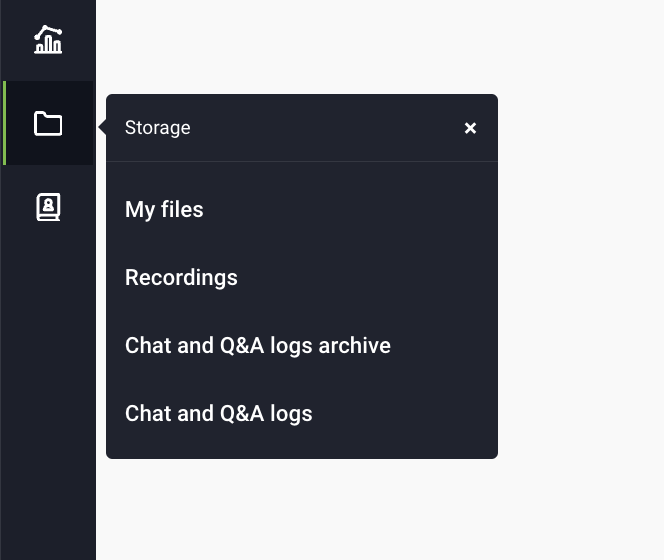
Here you will find all the recordings of webinars and meetings stored in your account. If the video of your last event is not there yet, no worries: it may appear with a slight delay. ClickMeeting supports common video files formats — MP4 and MOV — along with audio file formats including WAV and M4A.
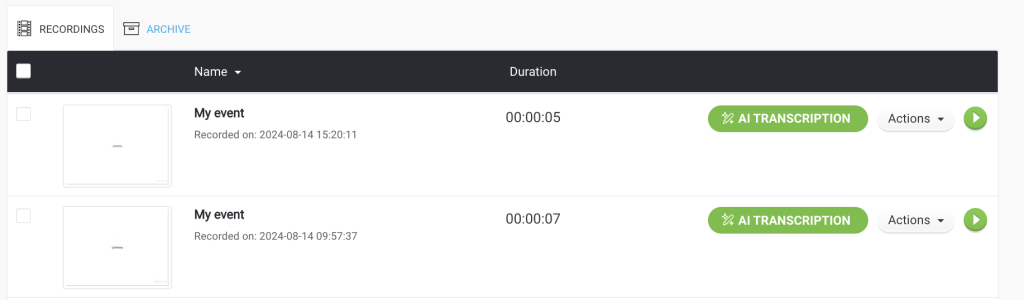
Now select the recording you want to transcribe and click the “AI transcription” button. In the next window, click “Start transcription.”
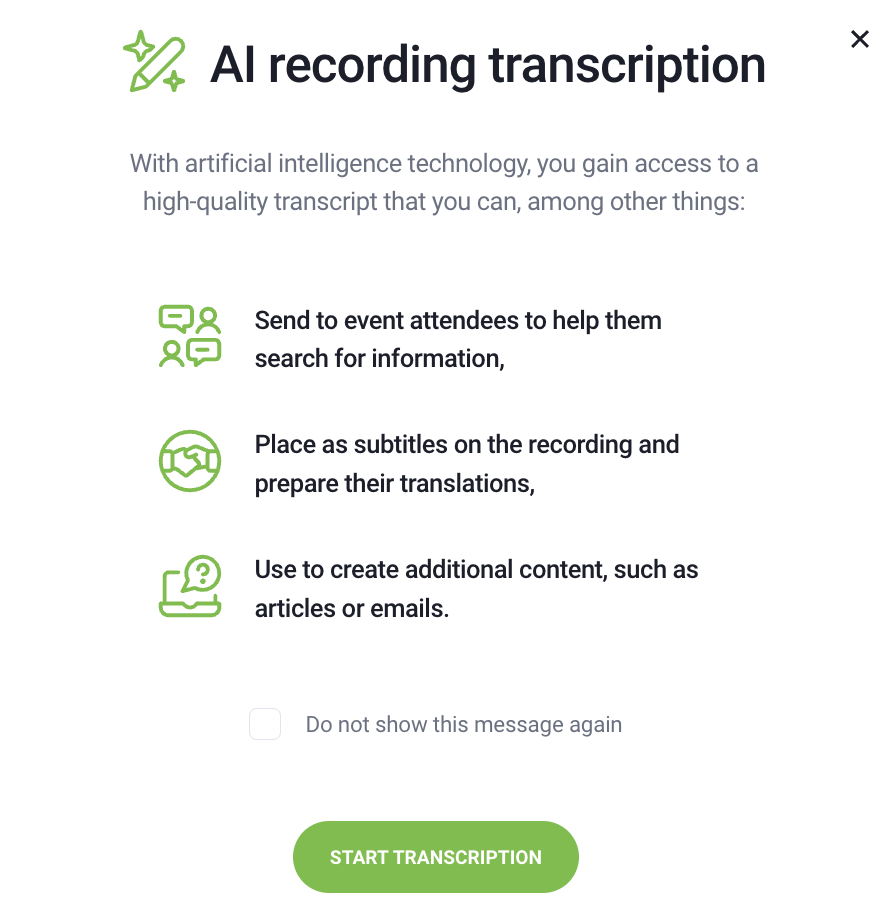
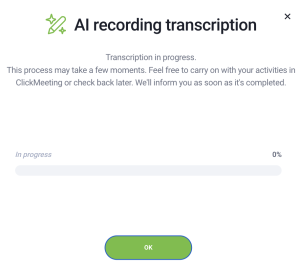
You don’t need to wait around while ClickMeeting starts transcribing. You can monitor the progress bar, or simply close the tab and take care of something else — like editing other recordings or creating new events. When the transcript is ready, you’ll receive a notification.
When your AI transcription is ready, click the “Download Transcription (TXT)” button. You will also find it directly in the recording library, right next to the recording it refers to. We will also send you a link to download the transcription via email.
The downloaded file is fully editable — you can open it in any text editor, correct errors, highlight key moments, and prepare it for whatever comes next.
Learn more about managing your recordings in ClickMeeting with this video:
What Can You Do with Your Transcript?
As you can see, it really only takes a few clicks to transcribe audio from a webinar or meeting recording. The transcript file becomes a versatile asset — here’s how to put it to work.
Send the Transcript to Your Event Attendees
Including a transcript in your post-event follow-up email is one of the most practical things you can do. It’s a genuine added value for your audience — especially for events with dense information, technical content, or complex discussions.
Think about attendees who joined from a noisy environment, or those who just want to search for key points without rewatching an hour-long recording. A searchable text file solves that instantly. They can search for a specific term, jump to the relevant section, and get what they need in seconds.
You can go further: let them know they can upload the file to AI tools like ChatGPT and use it as a knowledge base — asking follow-up questions, extracting quotes, or generating a personalized summary. That transforms your transcript from a static document into an interactive resource.
Create Subtitles for the Recording
Captions displayed on the recording significantly improve accessibility — especially for people who are hard of hearing, watching in a noisy place, or who are non-native speakers of the event language. They’re also standard practice on social media video today, from LinkedIn clips to short-form reels.
What’s important: you don’t have to match the text parts to the speech manually. The transcription file includes timestamps, so adding subtitles is straightforward. You can run the transcript through a tool like DeepL to translate it into another language, making your content accessible to a genuinely international audience — without recording a separate transcription for each language version.
This is one of the clearest examples of how a single audio or video recording becomes a multilingual content asset through AI.
Repurpose Your Webinar Content with AI Support
An online event can become the foundation for a complete content strategy. The transcript is your raw material — and with the right AI tools, turning it into blog articles, meeting notes, action items, or social media posts takes minutes rather than hours.
This approach is often called content repurposing. You can read more about it in this post. The basic idea: one well-produced webinar can feed your blog, your email list, and your social media channels simultaneously — all from a single transcript.
Here’s what you can extract:
- A long-form blog article summarizing the event’s key points
- A bulleted meeting insights summary for internal stakeholders
- Social media posts with pull quotes for LinkedIn or Twitter
- Follow-up emails with actionable next steps for attendees
- Clips or highlight reels based on timestamped transcript segments
And you don’t have to write any of it yourself. That’s where tools like ChatGPT come in.
“The AI transcription feature is something our users ask about constantly. It removes one of the biggest friction points after an event — turning a two-hour recording into usable content. When you can upload a file straight to ChatGPT and summarize the whole thing in 30 seconds, it changes how you think about your webinar workflow. The recording stops being an archive and starts being a content engine.”
Tomasz Bołcun
Brand Manager @ ClickMeeting
Step-by-Step Webinar Coverage with AI
To prepare this kind of content, you need only two things:
- A transcription file. You already know exactly how to create it in ClickMeeting.
- Access to ChatGPT. The free plan is sufficient.
After logging in, simply start a new chat. Then upload the transcription file by clicking on the stapler icon and locating it on your computer drive.
We are going to prepare a transcription of this webinar:
It is time to introduce the first prompt. It may go as follows:
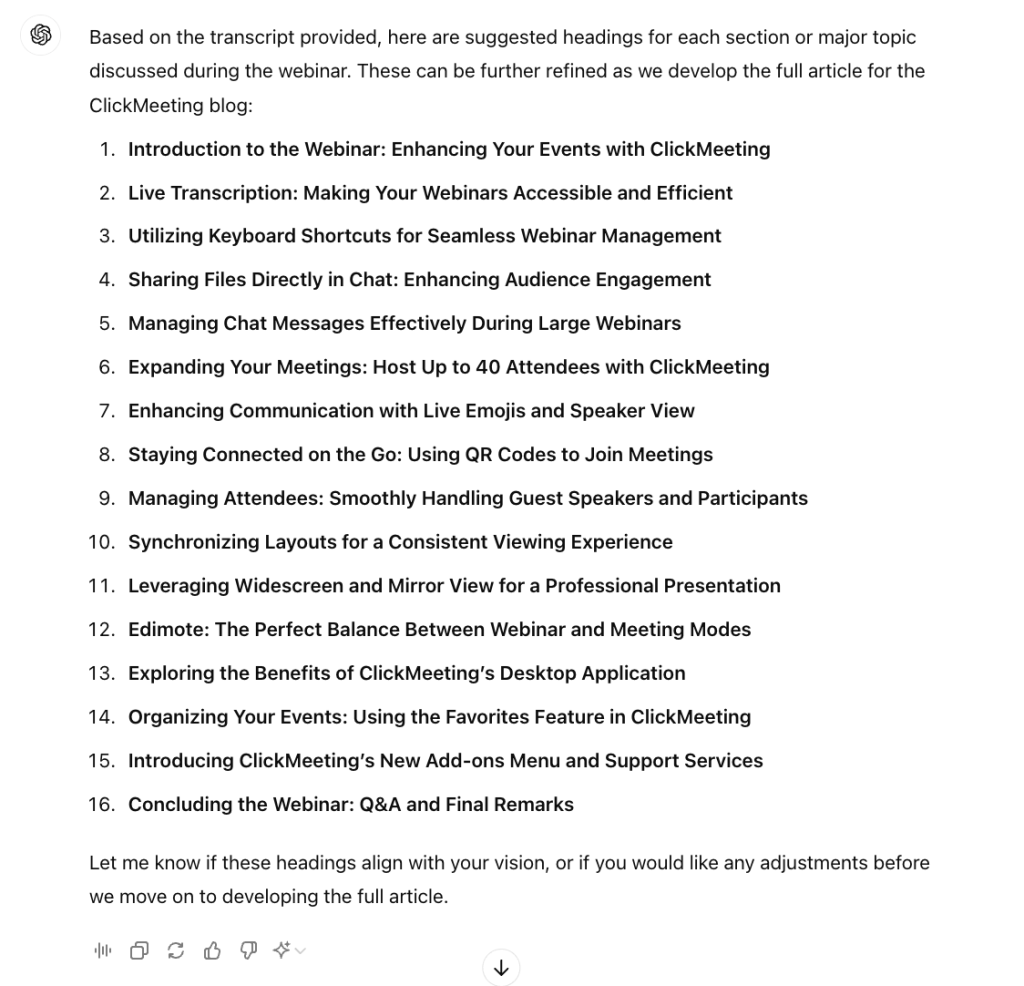
I will send you the text transcript of the webinar. Based on it, prepare suggested headings for each paragraph of the text report of the event. In the next step, we shall develop them into a long article that will be published on the ClickMeeting blog.
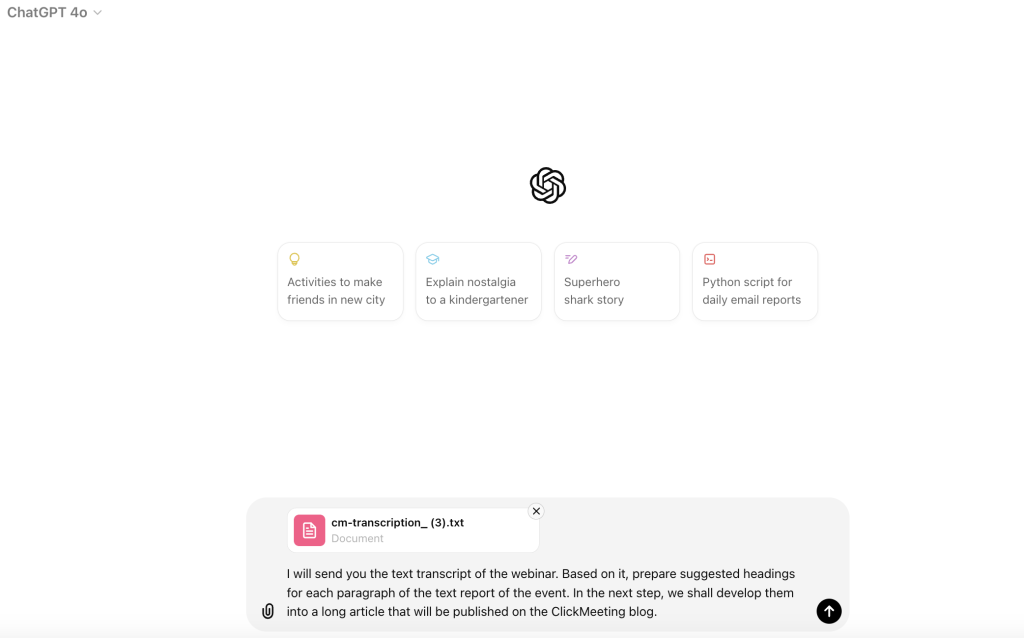
To get even better results, you can also upload files of other webinar reports that ChatGPT is going to follow. Let the tool know about it by adding a prompt:
Model on the style of the attached article
The result? We have headlines that can then be expanded to create a comprehensive and attractive article.
Very simple prompts will suffice:
Write the second paragraph of the coverage.
You can add additional commands, for example:
Write in a friendly and expert manner.
Use enumerations and lower-level headings to make the text visually appealing.
The result? Here’s a sample excerpt:
Live Transcription: Making Your Webinars Accessible and Efficient
One of the standout features of ClickMeeting is the live transcription capability, which is designed to enhance accessibility and ensure that your message is clear and comprehensible to all attendees. This feature automatically converts your spoken words into written text displayed on the screen in real time, allowing everyone to follow along effortlessly. Whether you’re hosting a multinational event or simply want to accommodate a diverse audience, live transcription can be a game-changer.
Key Benefits of Live Transcription:
- Improved Accessibility: With support for over 50 languages, live transcription ensures that non-native speakers and individuals who are hard of hearing can fully participate in your webinar. This inclusivity can significantly expand your audience reach and engagement.
- Enhanced Comprehension: Even for native speakers, accents and different speaking speeds can sometimes pose a challenge. Live transcription helps by providing a visual aid that reinforces the spoken content, making it easier for everyone to follow the conversation.
- Post-Event Utility: After your event, you can export the transcription in various formats like TXT, XML, or CSV. This is particularly useful if you plan to create subtitles for recorded sessions or if you want to provide a text-based summary for your attendees.
- Customizable Display: To ensure the transcription doesn’t interfere with your presentation, ClickMeeting allows you to adjust the size, color, and position of the text on the screen. You can even move the transcription box to different areas, ensuring it complements rather than distracts from your visual content.
Live transcription not only boosts accessibility but also adds a layer of professionalism to your webinars. It’s an essential tool for anyone looking to make their events more inclusive and engaging.
Social Media Posts and Emails
Following this pattern, you will prepare a complete blog article. But this is just one example — by properly shaping your prompts, you can generate any content type. A natural next step is writing a post linking to the blog article, ready to publish on your company’s social media.
Prompt:
Write a post encouraging people to read the blogpost, which you will post on ClickMeeting’s social media.
The result? A really good one!
🚀 Unlock the Power of AI for Your Webinars with ClickMeeting! 🚀
Ready to take your online events to the next level? 🎯 Our latest blog post dives deep into ClickMeeting’s top features that will not only enhance your webinars but also make them more accessible, engaging, and efficient. From live transcription to keyboard shortcuts, and everything in between, we’ve got you covered with expert tips and tricks!
🔗 [Read the full article here] – Your ultimate guide to mastering ClickMeeting starts now!
Don’t miss out on these insights that could transform the way you host and manage your events. 💡 Whether you’re a seasoned pro or just getting started, this blog post is packed with valuable information you won’t want to miss.
#ClickMeeting #WebinarTips #LiveTranscription #OnlineEvents #WebinarHosting #EventManagement
And another important thing you can’t forget if you’re creating webinars: a post-event email. It will help you build an even stronger relationship with your audience, and you can layer in additional goals — for example, encouraging people to use your offer or register for the next event.
The prompt can look like the following:
Write a mailing to webinar attendees and people who registered for the webinar but did not attend. Encourage them to review the recording of the webinar (include it in the email) and the text transcript, which you will send as an attachment. Encourage recipients to sign up for a free ClickMeeting trial account and take on the role of event organizer.
Subject: Missed the Webinar? Catch Up with the Recording and Transcript Inside!
Dear [First Name],
Thank you for your interest in our recent webinar, “Top 10 ClickMeeting Features to Boost Your Events”! Whether you joined us live or couldn’t make it, we want to ensure you get the most out of this valuable session.
📽️ Watch the Webinar Recording
We’ve included the full recording of the webinar for you to review at your convenience. Discover how you can leverage ClickMeeting’s powerful features to elevate your online events to new heights. [Include the link to the recording]
📝 Read the Full Transcript
For those who prefer to read, we’ve also attached the complete text transcript of the webinar. This detailed document covers all the topics we discussed, from live transcription to managing large-scale events, and everything in between. Feel free to refer back to it anytime!
🚀 Ready to Take the Next Step?
Now that you’ve seen what ClickMeeting can do, why not experience it firsthand? Sign up for a free trial of ClickMeeting and step into the role of event organizer. With our intuitive platform, you’ll be hosting professional, engaging webinars in no time.
[Start Your Free Trial Now](link to free trial signup)
Don’t miss this opportunity to turn your online events into impactful experiences. If you have any questions or need assistance, our team is here to help.
Thank you for being a part of our community, and we look forward to seeing you at our next event!
Best regards,
[Your Name]
[Your Position]
ClickMeeting Team
Is ClickMeeting’s AI Transcription Better Than a Separate Transcription Service?
This is a fair question, especially when you consider that tools like Otter offer a free AI transcription service with a certain number of transcription minutes per month. Otter’s appeal is real for individual users who want to transcribe audio from casual meetings or live calls. But for webinar organizers, the calculus is different.
Here’s why a built-in transcription tool wins for event use cases:
- No context switching. You record meetings directly in ClickMeeting and access transcripts in the same interface — no need to export audio or video files to a third-party platform.
- Supports multiple languages. ClickMeeting’s engine handles multiple languages natively, which matters for international audiences.
- Data privacy and security. Your audio recordings and transcripts stay within ClickMeeting’s infrastructure. The data is not used to train any AI model — a critical distinction for corporate and educational users.
- Instant transcription at scale. Whether you ran a meeting for 10 people or a webinar for 1,000, the process is identical — and your transcript is ready without any manual intervention.
- Separate transcription tools add friction. Every extra tool in your workflow means another login, another export step, another file to manage. For teams that record meetings weekly, that friction adds up.
That said, combining ClickMeeting’s transcript with an AI chat tool like ChatGPT gives you the best of both worlds: accurate transcription built into your event platform, plus flexible AI tools for content generation on top.
Ready to capture every word from your next event?
ClickMeeting includes AI transcription on all paid plans. Try it free for 14 days — no credit card needed.
FAQ — Frequently Asked Questions About AI Transcription
What file types does ClickMeeting’s AI transcription support?
ClickMeeting generates transcriptions from recordings made directly on the platform. The system handles common video files (MP4, MOV) and audio file formats (WAV, M4A) produced during webinars and meetings.
How long do I need to wait for my transcript to be ready?
You don’t need to wait long. ClickMeeting processes recordings quickly — for most events, the transcript is ready within a few minutes of starting the process. You’ll receive an email when the transcript is ready.
Does ClickMeeting’s AI transcription support multiple languages?
Yes. ClickMeeting’s transcription engine supports multiple languages and handles different accents reliably. The feature is well-suited for international teams and multilingual events.
Is the transcription editable after it’s generated?
Yes. The downloaded TXT file is fully editable. You can correct any errors, highlight key sections, add annotations, or restructure the content before sharing it or uploading it to another AI tool.
Is the transcription feature available on the free plan?
AI transcription is available on paid plans. If you’re on a free plan, you’ll need to upgrade to access this feature. You can explore all plans during the 14-day free trial.
Is my data used to train AI models?
No. ClickMeeting’s data privacy and security policy ensures that your audio recordings, video files, and transcription data are not used to train any AI models. Your content stays yours.
How does ClickMeeting’s transcription compare to tools like Otter?
Otter’s free AI transcription service is a good option for individual, casual use — Otter offers a limited number of transcription minutes per month on its free tier. For webinar organizers who need seamless integration, data security, and scale, ClickMeeting’s built-in transcription tool is a stronger fit because it eliminates the need to export and upload a file to a separate transcription service.
Can I use the transcription for live transcription during an event?
ClickMeeting also offers real-time transcription displayed during live calls — a separate transcription feature that shows captions on screen as the event unfolds. The post-event AI transcription described in this article is generated from the recording afterward.
Can I use the transcript with other AI tools like ChatGPT or Google Meet integrations?
Absolutely. Once you download the transcript, you can upload a file to ChatGPT (or any other AI chat tool) to summarize the content, extract action items, write follow-up emails, draft blog posts, or prepare meeting notes. This is one of the most practical use cases in a modern AI-powered workflow.
What’s the best way to distribute the transcript to my attendees?
The simplest approach is to include a download link in your post-event follow-up email, alongside the recording link. You can also host the transcript on your website, add it to a knowledge base, or bundle it as part of a paid content package if you monetize your webinars.